By using a combination of community-based treatment and rigorous monitoring, treatment courts reduce recidivism and the use of incarceration.
We developed New York City’s first drug court, the Brooklyn Treatment Court, and New York’s first mental health court, the Brooklyn Mental Health Court. Today there are thousands of such treatment courts across the country.
Drug courts bring together judges, prosecutors, defense attorneys, treatment providers, and court staff in a collaborative effort to address defendants’ substance use disorders. Due in part to a groundbreaking study by researchers from the Center for Justice Innovation, there is a broad consensus that drug courts reduce substance use and recidivism. In recognition of its work in this domain, the Center received the National Leadership Awardfrom the National Association of Drug Court Professionals.
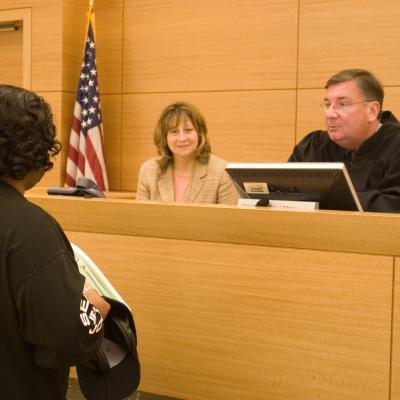
Mental health courts similarly link participants who would ordinarily be prison-bound to long-term community-based treatment. They rely on thorough mental health assessments, individualized treatment plans, and ongoing judicial monitoring to address both the mental health needs of offenders and the public safety concerns of communities.
Initiatives
Brooklyn Mental Health Court
The Brooklyn Mental Health Court offers community-based treatment in lieu of incarceration to defendants with serious mental health diagnoses.
Brooklyn Treatment Court
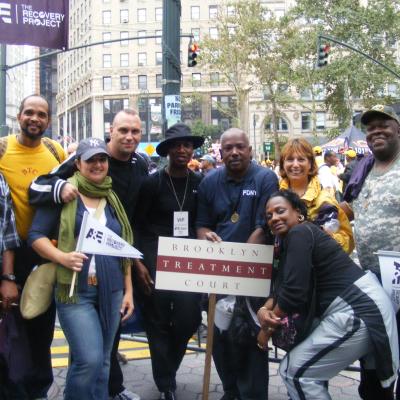
The Brooklyn Treatment Court links defendants with substance use disorders to treatment as an alternative to incarceration.
Training and Technical Assistance
We provide training and technical assistance to treatment courts across the United States.
Statewide Strategic Planning for Problem-Solving Courts
We provide thoughtful planning and coordination for problem-solving courts to ensure best practices and the best possible outcomes.
In 2019, the Center for Court Innovation received funding from the Bureau of Justice Assistance to assist five states in the development and implementation of statewide strategic plans for their Veterans Treatment Courts (VTC). The selected states were California, Maine, Ohio, Pennsylvania, and Virginia. Each state participated in a needs assessment process that included a document analysis and stakeholder interviews.
The first mental health court in New York City, the Brooklyn Mental Health Court seeks to craft meaningful responses to defendants with mental illness. Addressing both treatment needs and public safety concerns, the court links defendants who have serious and persistent mental illnesses (such as schizophrenia and bipolar disorder) or Neurodevelopmental disorders (such as Autism spectrum disorders, intellectual disabilities, and ADHD) who would ordinarily be jail- or prison-bound to long-term treatment in the community.
This Urban Institute evaluation of two mental health courts in New York City finds that mental health court participants are significantly less likely to recidivate, as compared to similar offenders with mental illness who experience business-as-usual court processing.
A conversation with our Recovery and Reform team on their new name, the intersection of the justice system and substance use, and taking on racial disparities in treatment courts.
In this article, our Director of Treatment Court Programs Monica Christofferson comments on the increasing acceptance of medication for opioid use disorder (MOUD) in the drug court system. The story follows Tennessee Judge O. Duane Slone, his pilot programs with MOUD, and the successful recoveries of participants like Rachel Solomon. In short, as Christofferson put it: “MOUD works.”
For over 20 years, the Brooklyn Mental Health Court has been working to keep people with severe mental illnesses out of jail and in treatment. Hear from Judge Matthew J. D'Emic, who has presided over the court since its inception, on the importance of this work.