Midtown Community Court

Overview

Launched in 1993, the Midtown Community Court targets quality-of-life offenses, such as prostitution, illegal vending, graffiti, shoplifting, farebeating and vandalism. Typically in these cases, judges are forced to choose between a few days of jail time and nothing at all—sentences that fail to impress the victim, the community and the defendants that these offenses are taken seriously. In contrast, the Midtown Community Court sentences low-level offenders to pay back the neighborhood through community service, while at the same time offering them help with problems that often underlie criminal behavior. Midtown's judge has an array of sanctions and services at her disposal. These include community restitution projects, short-term psychoeducational groups, and long-term treatment such as drug treatment, mental health treatment, and trauma-focused psychotherapy. Midtown features an on-site clinic staffed by social service professionals who use trauma-focused, strengths-based, and evidence-informed clinical approaches to assess and connect individuals to appropriate services. To read more about research results, including caseload, sentencing, compliance and other outcomes, click here.

How It Works

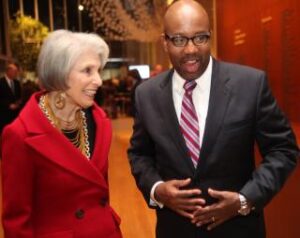
New York State's Chief Judge Judith S. Kaye (Ret.) (second from left) with fellow keynote speakers, from left, British Secretary of State Lord Falconer of Thoroton, Chief Administrative Judge Jonathan Lippman and New York City Mayor Michael Bloomberg at the Midtown Community Court's 10th Anniversary.New York State's Chief Judge Judith S. Kaye (Ret.) (second from left) with fellow keynote speakers, from left, British Secretary of State Lord Falconer of Thoroton, Chief Administrative Judge Jonathan Lippman and New York City Mayor Michael Bloomberg at the Midtown Community Court's 10th Anniversary.The Court achieves the following:

Making Justice Visible: Wearing bright blue vests, quality-of life offenders at Midtown pay back the community through visible community service projects—painting over graffiti, sweeping the streets, and cleaning local parks.

Making Justice Swift: Immediate sentencing sends the message to offenders that crime has consequences and that they will be held accountable for their actions. Offenders often begin their sentences within 24 hours of appearing before the judge.

Engaging New Partners: The Court works with local residents, businesses, social service providers and other government agencies to forge creative, collaborative solutions to neighborhood problems. The Court houses an array of non-traditional programs, including community mediation, GED classes and job training for out-of-school youth, and homeless outreach.

Offering Social Services: The Court uses arrest as a gateway to treatment, engaging defendants in on-site drug and mental health treatment, and job training.

Providing Better Information: The Court's award-winning computer application helps the judge craft individualized sanctions for each offender and monitor compliance. The system also provides police officers with regular feedback about the outcomes of their arrests.

Results

New York City Mayor Michael Bloomberg has hailed the Midtown Community Court for helping to revive Times Square. Midtown Community Court was also the subject of an independent evaluation by the National Center for State Courts. According to the National Center, Midtown's compliance rate of 75 percent for community service was the highest in the city. Offenders performing community service contribute hundreds of thousands of dollars worth of labor to the community each year. In conjunction with aggressive law enforcement and economic development efforts, the Court has had an impact on neighborhood crime: prostitution arrests dropped 56 percent and illegal vending was down 24 percent. There are currently dozens of cities around the world that have opened or plan to open community courts based on the model of the Midtown Community Court. The Court has received awards from the National Association for Court Management, Municipal Art Society, Encore Community Services, the 9th Avenue Association, Windows World Open and the Broadway Association.

Partners

The Court is operated as a public/private partnership among the New York State Unified Court System, the City of New York and the Center for Court Innovation. During the Court's pilot period, funding came from a mix of sources, including the federal government, local government and dozens of foundations and corporations. Social service and community service partners include dozens of community-based and government agencies.

Upcoming Events
Featured Research

Publications

The Adolescent Diversion Program: A First Year Evaluation of Alternatives to Conventional Case Processing for Defendants Ages 16 and 17 in New York

By Michael Rempel, Suvi Hynynen Lambson, Carolyn R. Cadoret and Allyson Walker Franklin

This report examines the first six months of a pilot Adolescent Diversion Program for court involved 16 and 17 year-olds at nine sites in New York State. The study found that diverting these youth to services does not increase recidivism rates and, in fact, reduces recidivism for those who would otherwise pose the greatest risk to public safety.

Read a summary of the study

Listen to an interview with the researchers

Publications

Adolescent Diversion Program: Research Findings

A summary of the research report The Adolescent Diversion Program: A First Year Evaluation of Alternatives to Conventional Case Processing for Defendants Ages 16 and 17 in New York, which examines the first six months of a new pilot program at nine sites in New York State. The impact analysis found that program participation does not increase recidivism overall and is most effective with high-risk youth, for whom it actually reduces re-arrests.

Read the full evaluation

Listen to an interview with the researchers

Video

The Short Answer: What Principles Guided the Creation of the Midtown Community Court?

John Feinblatt, senior advisor to New York City Mayor Michael Bloomberg and founding director of the Midtown Community Court, talks about the principles that guided the creation of the Midtown Community Court?

@MIDTOWNCOURT
  • MidtownCourt: Recruiting for a new cycle of the Workforce Development & #Fatherhood Program! http://t.co/SXmvkzODCi #jobs #dads #nyc

    Read More
  • MidtownCourt: RT @verainstitute: The 3 objectives of @NASciences report on reforming juvenile justice: accountability, fairness & reduce recidivism http:…

    Read More
  • MidtownCourt: Treatment helps offenders-and saves taxpayers money: http://t.co/ObRr6nqRkX. Read @Courtinnovation's report here: http://t.co/8dofljRuNt

    Read More
Contact
  • New York
  • 520 8th Avenue
  • 18th Floor
  • New York, NY 10018
  • phone: 646.386.3100
  • Syracuse
  • One Park Place
  • 300 South State Street
  • Syracuse, NY 13202
  • phone: 315.266.4330
  • London
  • Kean House, 6 Kean Street
  • London, WC2B 4AS
  • phone: +44 2076.329.060